


Forbes Romania continued its mission to connect ideas, people, and opportunities across continents through the second edition of Forbes Business Bridges 2025, held on October 8th at the iconic Forbes on Fifth in New York City.
After the resounding success of last year’s debut edition, this year’s event once again brought together visionaries from Romania, the United States, and the broader CEE region — leaders shaping the future of industries such as IT, finance, logistics, production, and real estate.
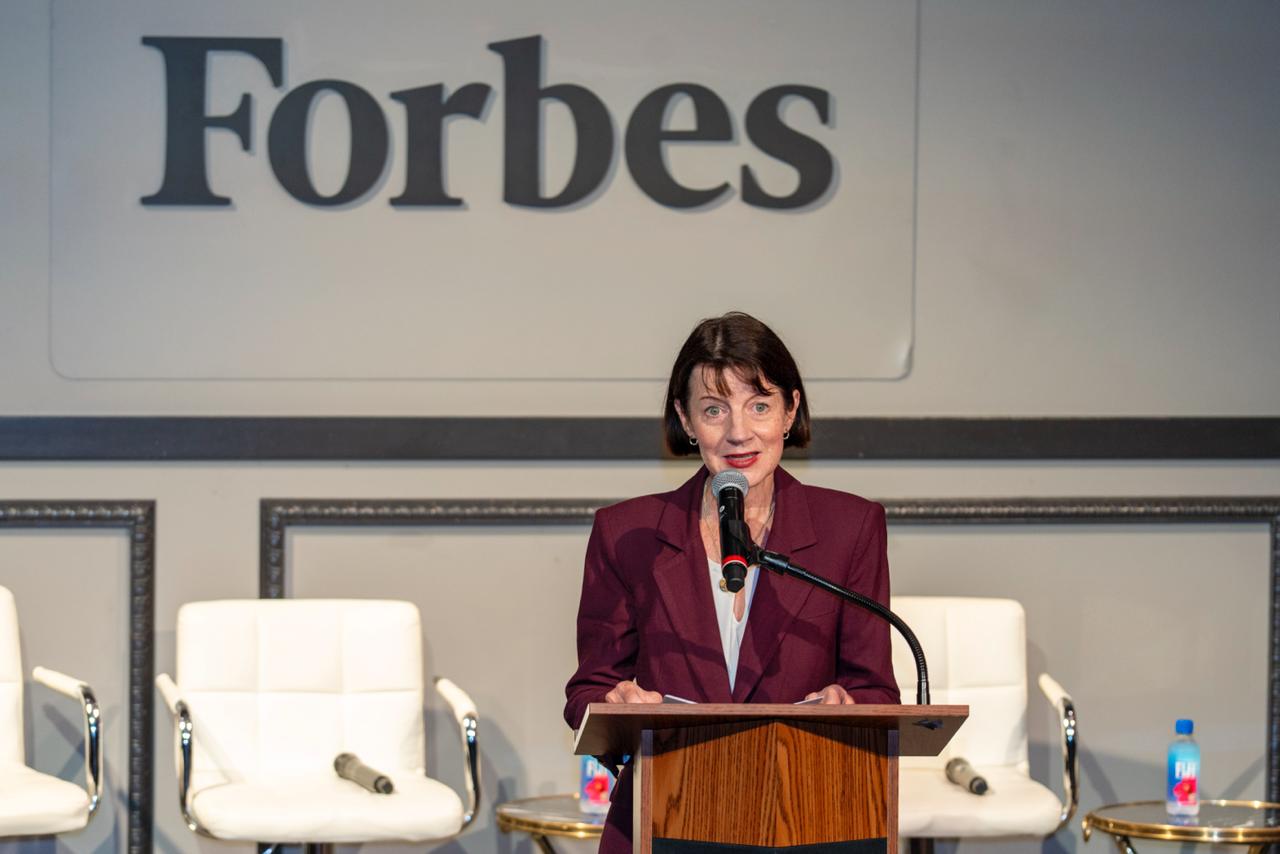
The event opened with inspiring remarks from Kerry A. Dolan, Assistant Managing Editor, Global Editions:
„Good morning, everyone. I’ve been with Forbes for 31 years. I started working here in New York in 1994 and then moved to San Francisco in 2000. I was part of the editorial team for a very long time, editing our lists of the world’s billionaires and other rankings of the richest Americans. Recently, I transitioned to a new role on the team that works with our global partners — including Forbes Romania — so I’m truly happy to be here this morning.
It’s an honor to help open this landmark event here at Forbes on Fifth, where Forbes Romania is carrying on the tradition established by Forbes magazine: celebrating entrepreneurship and success in business.
Since I’ve been with Forbes for such a long time — and because I’m a fan of anecdotes from history — I thought I’d share with you a little bit of Forbes lore.
Steve Forbes, our Editor-in-Chief and the grandson of Forbes founder B.C. Forbes, often cites his grandfather’s wisdom, including this: in the very first issue of Forbes, published 108 years ago in 1917, B.C. Forbes wrote, “Business was originated to produce happiness, not to pile up millions.”
Well, sometimes I think you can do both — because we’ve certainly got plenty of millionaires and even billionaire business owners today.
B.C. Forbes’ son, Malcolm, a savvy businessman who took over as Editor of Forbes after B.C. passed away in 1954, never forgot about happiness. Malcolm infused Forbes magazine and the brand with the idea that success and wealth are best enjoyed while living life to the fullest.
For his 70th birthday in 1989, Malcolm Forbes threw a legendary party for 800 guests at his palace in Tangier, Morocco. His date for the evening was the famous actress Elizabeth Taylor. Guests were greeted with fireworks and rose petals, and entertained by hundreds of Moroccan dancers, acrobats, and cavalry. The event was described as a who’s who of corporate America, with prominent figures from the worlds of business, media, and politics in attendance.
Malcolm Forbes was also a huge fan of Harley-Davidson motorcycles and hot air balloons. For many years, in the lobby of Forbes’ Silicon Valley office — where I worked before our move to San Francisco — there stood one of the motorcycles Malcolm rode across China on a 10-day trip in 1982. Malcolm, his son Tim Forbes, four teammates, and two cameramen were the first non-Chinese to ride motorcycles across the country, from Xi’an in the west to Beijing. He even brought along a hot air balloon emblazoned with the Forbes logo, which he took up on tethered rides whenever they stopped in major cities.
You have to hand it to Malcolm — he had quite an imagination for unusual marketing.
Back to the original founder — what did B.C. Forbes mean by saying that business should produce happiness? I believe his message was that business creates contented customers, satisfied employees, and, ultimately, adds value to society.
And that brings us to today. This forum brings together some of the brightest minds and most accomplished leaders who are doing just that — adding value to society. Today’s speakers will explore challenges and opportunities across several key industries — from AI to luxury retail, to wealth management and real estate.
Not only are we here to build crucial bridges, as Raluca mentioned, but also to learn from these distinguished speakers about their journeys to success — and perhaps some of the challenges they’ve faced along the way.
Of course, news about artificial intelligence — or AI — is everywhere. Since the launch of ChatGPT, we’ve witnessed unprecedented investments from venture capitalists into AI, and now AI companies themselves are investing heavily into other sectors. This morning, I read that an estimated $1.2 trillion has already been allocated to AI ventures — much of it driven by the fear of missing out. So much money is being poured into this space despite all the uncertainties.
Today’s discussions will shed light on the complexities surrounding AI and the digital frontier.
In the luxury sector — as many of you here know well — the landscape is evolving. There’s been a significant drop in luxury goods consumption in parts of Asia, led by China. Many luxury brand owners have seen a decline in their stock values. Yet, there remains a strong core demand for luxury goods. So, what is the best way to navigate the luxury business in these shifting sands?
The real estate industry, particularly the commercial sector, faces its own set of challenges. Depending on which city you live in, vacancy rates for commercial real estate can range from nearly 35% in San Francisco, where I live, to about 16% here in New York, and around 10% in Bucharest. What does the future hold for commercial real estate, and how can stakeholders adapt to these changes and challenges?
As we embark on today’s forum, I encourage all of you to engage in dialogue, share your insights, and collaborate. Together, we can forge powerful connections that will strengthen the economic ties between the U.S. and the European Union.”