


From a family-owned jewelry store in Pitești to an international luxury brand, TEILOR has become one of Romania’s most remarkable entrepreneurial success stories.
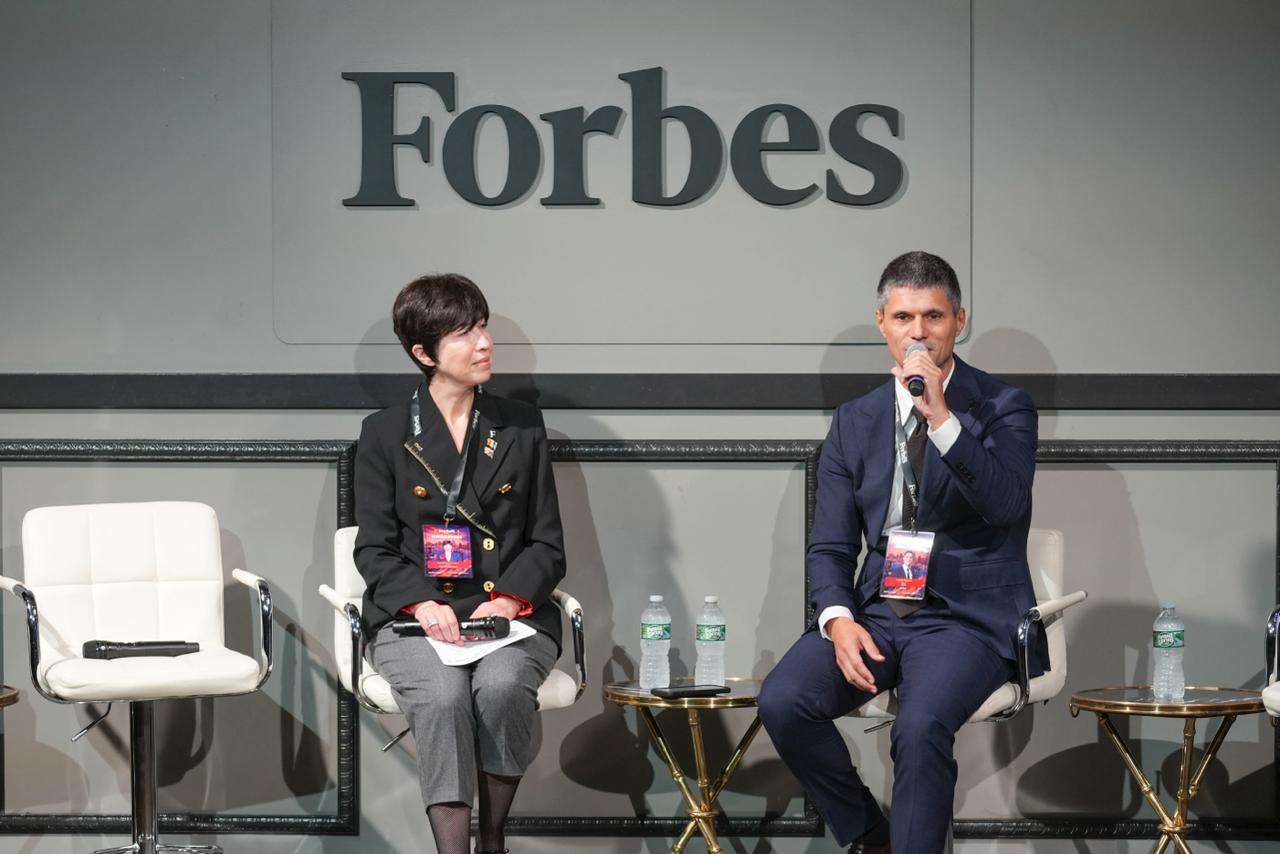
In an exclusive one-to-one conversation at Forbes Business Bridges 2025 in New York, Florin Enache, Owner of TEILOR, shared his perspective on building a brand that transcends borders while staying authentic to its roots.
Below are the main insights shared by Florin Enache:
Question: Now, Teilor — Romania’s leading jewelry retail brand — started in 1998 with a single gold jewelry store on Teilor Street in Pitești. Since then, the company has grown tremendously into a major player in the luxury jewelry market. Teilor has evolved into a true symbol of elegance and sophistication, expanding across Romania with over 75 stores and a powerful online presence. They’ve managed to redefine elegance through both their digital platforms and their in-store experience.
Florin Enache: First of all, thank you very much, Raluca, for inviting me. And sorry for my English — I’m not a native speaker. There’s actually a funny story about that. More than ten years ago, I couldn’t say almost anything in English. I asked myself: How can I learn fast? So I brought in a student through a program from a Brazilian university — though he was actually from Bulgaria — to stay with us for about three or four months. I wanted to apply for an Executive MBA, where I knew I’d be forced to use English every day.
So, for four months, I studied with his help. Then I went to school, and during the first month, I didn’t understand anything.
I still remember: the first class was Business Strategy, taught by a professor from Singapore. There were about 70 students from different nationalities, and I was trying to hide behind someone in front of me so the teacher wouldn’t ask me anything. The first module was somewhat manageable, but the second one was about statistics and economics. They filled the board with linear and multiple regression equations — extremely difficult! I thought, This isn’t for me. I didn’t understand a thing. So I went home.
Then the program director called me and said, “Florin, you have to come back. If you quit now, you’ll never return.”
I told him, “But I understand less than 20% of what’s being said!” And he replied: “This class isn’t about how fluent you are in English — it’s about what you bring to the table: your know-how and your attitude.”
That made me come back. A year later, I returned and completed the program. It lasted 14 months, but it felt like 10 years. Still, that’s how I learned my English.
Coming back to your question, Raluca — 25 years ago we started this company, Teilor, named after the street where we opened our first store. “Teilor” means linden tree in Romanian. I didn’t have any money for marketing or any team behind me to promote the brand. So I thought, The best way to bring people in is to use the name of the street — everyone already knows it.
It’s like in New York — if you open a jewelry store on Fifth Avenue, you might call it “Fifth Avenue Jewelry.” That’s how Teilor was born.
At first, we were just small traders, buying existing jewelry collections from all over the world and selling them in our shop. Every day we grew a little bit more. But back then, I had no big vision. If you’d asked me 25 years ago what my plan was, I would have said, I just want to get a bit better every day.
Exactly. Now, after 25 years, we’re listed on the stock exchange, we’ve raised capital, and we’re expanding abroad. Today, with over 1,000 people in the company, we have a clear direction and a lot of expertise. But at the beginning, we knew nothing.
Still, there are four things that I believe made us successful.
First — our people. In luxury, the real experience happens in the store. Technology and AI help us with operations and logistics, but what truly matters is the human experience. When people buy luxury, they don’t only remember the product — they remember how they felt.
Q: You told me yesterday about your experience buying from Tiffany — they didn’t have your item in stock, right? They shipped it from Paris, but when it arrived, it wasn’t wrapped properly — right? Not wrapped at all. It was actually bubble-wrapped — quite disappointing.
Florin Enache: Exactly. At this level, people expect exceptional design, packaging, and attention to detail — things that make them feel something. That’s why we focus so much on our people. They’re the interface between the brand and the customer.
We even have our own in-house training academy for all our 1,000+ employees, where we constantly teach them how to create memorable experiences. That’s one of our pillars.
The second pillar is our stores. The design of each store matters immensely. We currently have over 100 stores, and building each one can take up to a year and a half. Every material, every detail is custom-made.
Twenty years ago, when I traveled, I didn’t spend my time in restaurants or shops — I took thousands of photos of architecture, design, hospitality spaces, and hotels. I’d come home, show them to my architect, and say: How can we create something like this? That’s how Teilor’s visual identity evolved.
When customers enter our stores, everything — down to the chairs and fabrics — is chosen to evoke emotion. Because in luxury, it’s not just about the intrinsic value. Gold is gold, and a diamond is a diamond. What matters is the feeling and memories that come with it. Jewelry carries emotions — you give it to your mother, your daughter, your partner. It becomes part of your story.
We even worked with an Italian company for months to develop our in-store scent — inspired by the linden tree. I personally smelled over 1,000 variations before we chose the right one.
The third pillar is our marketing. We have a team of over 30 people, and everything — absolutely everything — is done in-house: from brief to creation, strategy, storytelling, copywriting. In the beginning, we didn’t have the budget to hire big agencies, so we learned along the way.
I remember visiting Tiffany with my twin daughters recently — they bought some coffee cups. In a small room, they were playing Breakfast at Tiffany’s with Audrey Hepburn on a screen. Suddenly, even a simple cup felt special. That’s what great marketing does — it creates emotion and meaning. That’s what we’re trying to achieve with Teilor, to build connections and emotions, not just sell jewelry.