


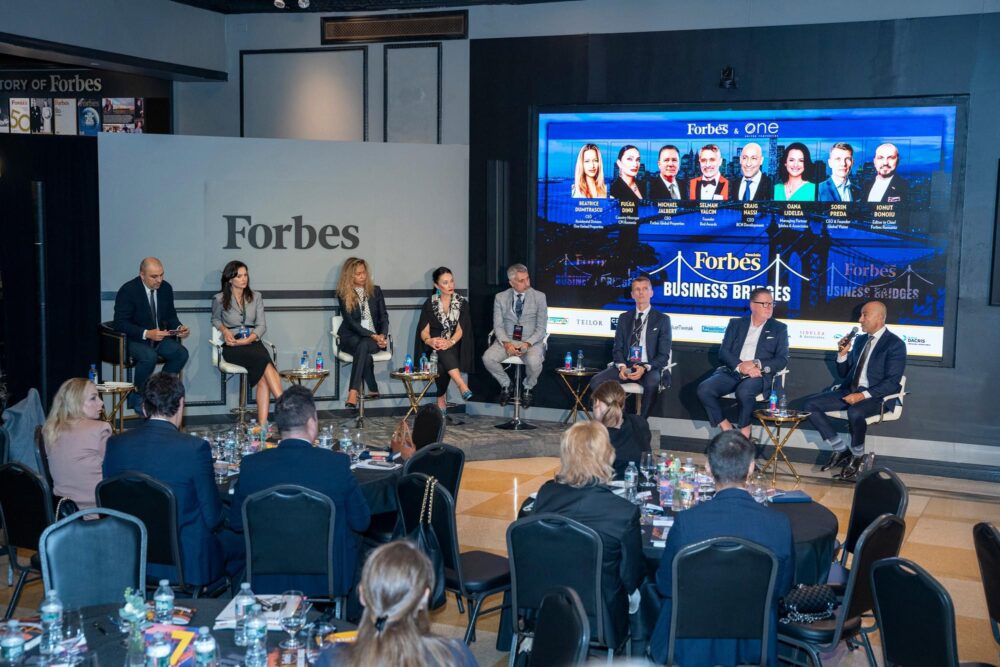
At the Forbes Business Bridges event held in New York this fall, panelists engaged in a compelling discussion about the future of the real estate landscape, exploring significant trends that are shaping the industry.
The third panel, titled “The Real Estate Landscape of Tomorrow – Trends That Make Sense,” featured a diverse group of experts who shared their insights on emerging opportunities and challenges in real estate, emphasizing the importance of adaptability, digital transformation, and local partnerships in navigating the evolving market landscape. Mrs. Beatrice Dumitraşcu highlighted the significance of Bucharest’s expansion and the emotional connections that underpin real estate transactions. Mrs. Fulga Dinu reflected on the need for creativity and adaptability in response to post-pandemic changes, while Mr. Jalbert emphasized the value of trust and transparency in building successful relationships. Mr. Yalcin discussed the role of technology and collaboration with local developers, and Mrs. Oana Ijdelea focused on sustainability as a driving force in the industry. Mr. Preda shared his vision for an integrated approach to real estate, technology, and energy, while Mr. Nassi noted the impact of finance on real estate trends in New York.
Overall, the discussion revealed a collective vision for a sustainable and innovative future in real estate, emphasizing the importance of collaboration, adaptability, and a forward-thinking approach to emerging trends.
Key statements of PANEL III: The Real Estate Landscape of Tomorrow – Trends That Make Sense
Beatrice Dumitrașcu – CEO, One United Properties (Residential Division)
There are many valuable insights when discussing opportunities and what is truly important. I represent a company that develops real estate in Romania. We are currently the market leader, catering to both the mid-market and the luxury market segments. Our primary focus is in Bucharest, where our main developments are located. I believe the most important thing happening today is the expansion of Bucharest. This is a key piece of information for several reasons.
Earlier, we discussed predictability, but this kind of expansion doesn’t happen often, which is why it is so significant right now. For example, a lot of construction is set to take place around Bucharest, and, in my opinion, it will be a game-changer in the coming years. This is just one perspective.
I also want to point out that, whether we like it or not, digital transformation is happening. It began long before we even realized it, much like the evolution of the web, as discussed in the previous panels. What I know for sure is that most of our portfolio consists of housing, and I am confident that AI won’t replace us. Why, you ask? Because we are selling emotion before we sell a house. The emotional connection always comes first.
Then comes rationality – you realize that you need to buy a house, you assess your financial situation and decide to purchase because you want to. But that initial decision is always driven by emotion. As human beings, we are social creatures. We need emotional connections and face-to-face interactions, especially when making decisions about buying a home. While office spaces, as Fulga mentioned, can be sold over the phone due to digitalization, selling a home is different. I can sell a house – or even multiple houses – to an investor, but that is a different type of transaction.
However, when someone is buying for themselves, it’s different. They need to speak with someone, and this isn’t going to change just because we are in the digital age.
I also want to point out that, most of the time, it’s about recognizing opportunity. I love my country, and I’m confident that Romania is a place where you can make significant investments. It’s a land of opportunity. Geopolitically, we hold a very important position on the map right now. Bucharest is a beautiful city, and our country is equally stunning. We have everything, from seaside to mountains, which makes Romania a great place to live year-round. Not to mention that our housing prices are still very low.
We offer competitive prices on apartments and cover all market segments. There is a huge opportunity for development, because Romania still requires substantial infrastructure. It’s a country where, if you have the right expertise and find a local partner, you can achieve a lot. For instance, in the housing sector, we currently have three buyers competing for a single unit because there isn’t enough housing being developed in Bucharest or across Romania. This represents a massive opportunity to invest here. Although we operate in various industries, I can speak confidently about real estate, having worked in this field for 20 years. There is enormous potential, and I invite you all to come and invest.
What’s interesting is that Romania is a young market. For example, property conversions are progressing slowly because we’re not yet accustomed to them. There’s still plenty of land to build on, and a lot of refurbishment work is being done, particularly in the old city. We’re making significant progress. Regarding conversions, we’re currently working on an office building, and it’s showing improvement. It took us a year to educate our clients and convince them to consider this type of property. Initially, their reaction was, “Oh, come on, I need something new,” because Romanians have always aspired to be homeowners. With more than 95% of Romanians owning their homes, this is clearly a market where homeownership is a common aspiration.
However, since we’re not building enough to meet demand, the market is starting to develop as more investors enter the scene, coming from other parts of Europe, especially Eastern Europe, where there’s less available inventory. They’re buying 500 to 1,000 apartments to build portfolios for rental. Why? Because younger generations are less inclined to become homeowners – they’re more open to renting. As a result, the market is shifting, and investors are aware of this trend. Having experienced this transition in other countries, they know where the market is heading. It’s a very exciting time, with huge opportunities ahead.
Fulga Dinu – Country Manager, CPI Romania
Hello, everybody. Thank you for having me. When Raluca mentioned the idea of hosting this conference in New York, she didn’t even get to finish the sentence before I said yes. I feel a strong connection to this bridge concept that you’re highlighting. I emigrated to the U.S. in 1996, went to school here, and later worked here. After six years, I moved back to Romania with the hope of bringing everything I had learned in the U.S. to a country emerging from a difficult period. I’ve tried to integrate what I learned here – such as the positive attitude, the directness, the problem-solving mindset, and the focus on efficiency – into the way we conduct business in Romania. I now lead one of the largest commercial real estate companies in Romania.
To get straight to the point, one of the most important trends I’ve noticed, especially in the past few years since the pandemic, is the ability to adapt and change quickly.
We repurposed some of our buildings, transforming them so they continued to generate revenue. I believe creativity and adaptability are crucial for staying relevant, which includes investing in AI. While AI is important for us in real estate, I don’t see it as a major game changer. It will certainly benefit us, but it won’t replace people, except maybe in smaller, more repetitive tasks. What’s important is that we continued to generate income and even increased our revenues post-pandemic, despite the challenges faced by the office market.
I always try to see the glass as half full. Just to give you an example, when I moved here in 1996, I was corresponding with friends and family through letters sent by mail. I still have stacks of those letters at home, because international calls were very expensive. Yet, two days ago, I completed a multi-million-dollar transaction from New York that was signed in Bucharest. This highlights how technology has simplified our lives. And I firmly believe in it. It has its downsides, of course – my daughter, for instance, spends way too much time on Instagram (Gen Z, right?) – but it greatly helps with tasks like reporting, by improving accuracy, and reducing human error. Reporting existed 20 years ago, of course, but it was quite rudimentary. Now, thanks to technology and AI, we can generate reports that are both meaningful and accurate.
We can map our buildings with much greater precision and implement more efficient building management systems, which, in turn, help reduce environmental impact. I’m a strong believer in this. As some of the previous panelists mentioned, this transition won’t lead to massive job losses. Employees can retrain, much like they did during the Industrial Revolution when people feared the decline of manual labor. It’s simply a matter of retraining, and I believe people will adapt. I’m optimistic. If things do go wrong, we’ll cross that bridge when we get to it, but I don’t think that’s likely.
I believe Romania is at a significant advantage because we had very little to begin with. For example, the first modern shopping center in Romania just celebrated its 25th anniversary a couple of weeks ago. The first Western-standard office building is barely 20 years old. As a result, we have high-quality real estate and assets because we’ve leapfrogged certain stages of development. Emerging from communism and the Ceaușescu era, we had nothing. Many people went abroad to get education, returning with knowledge that allowed us to implement best practices right from the start – unlike in other countries, where development was more gradual.
The other day, I was walking through Hudson Yards. If it weren’t for the surrounding environment, you could easily think you were in one of our malls. That’s how similar they are. And it’s not just our malls; the competition is equally impressive. I have clients and business partners here who have stores in our malls, and honestly, I rarely see stores as beautiful as theirs, even on Fifth Avenue. We don’t market ourselves enough, which is why I was eager to attend this conference – we have a lot to offer. We are professional. Of course, there are always a few bad actors, but that’s true everywhere. If you know who you’re dealing with, you’ll find that Romania’s real estate market is very professional. It has become a market with well-prepared individuals who understand the business and know finance.
I’ve completed transactions here, and although they weren’t as large as those I handled at JP Morgan, the complexity and quality were comparable. Romania’s real estate market is on par with global standards. To add to what Beatriz said, from an investor’s perspective, it’s crucial to understand a country’s risks. However, Romania is a member of NATO and the European Union, and we are on the cusp of joining the Schengen Area. At the beginning of my speech, I noted that, post-COVID, Romania also experienced an increase in remote work. However, things are looking up for us now. In our portfolio, we have a 75% occupancy rate, which is great. The remaining 25% is mainly represented by American tech and financial companies, which still have work-from-home policies. But people in Bucharest and throughout Romania have expressed a desire to return to the office.
During the months following the lifting of the restrictions, we converted some of our buildings into hospitals, thus addressing a niche in Romania’s public health system, which has significant gaps and a significant demand for private hospitals and clinics. These conversions have been highly successful: we secured 25-year leases under excellent terms. There’s hardly a more rewarding industry than this!
To conclude, I believe the two pillars symbolizing this gathering are critical. After witnessing the transformation of the Hudson Yards area, which was unrecognizable 20 years ago, I realized that New York can give you 200 new ideas every few blocks in terms of real estate. It’s an incredible source of inspiration, and I love this city. At the same time, I believe Romania also has a lot to offer. Americans, particularly New Yorkers, should consider Romania rather than constantly looking the other way. This largely sums up my perspective on building this bridge.
Michael Jalbert – CEO, Forbes Global Properties
Our specialty lies in transacting business for high-net-worth and ultra-high-net-worth individuals across 30 countries, supported by 600 offices and 19,000 agents. Frankly, I envision the future the same way as I have the past. There are three levels to conducting business in this sphere. First, you must build a relationship, which is often very personal, with the buyer or seller. This relationship can take anywhere from a month to 10 years to develop, but nothing happens until you establish that relationship.
The second step occurs when that relationship evolves, leading the client to seek your advice and see you as a trusted advisor. Only when you reach that level of trust will you be invited to participate in a transaction, whether representing the buyer or the seller. There are many facets to building these three levels, but the fundamental process remains unchanged.
You must know your clients, and you must know your business. Looking across the 30 countries where we continue to grow, I would say that real estate transactions are about 80% the same across markets. However, the remaining 20% varies, and local expertise is crucial for understanding the differences and achieving success. So, while names, safety, security, and growth may vary, if you don’t have these basic principles in place moving forward, it’s not going to work.
I believe the pandemic has propelled us into the next phase of leveraging technology in this industry. For example, before the pandemic, if you were an international buyer looking to invest in Portugal, it would easily take you three to four months to complete the transaction, including personal visits, meetings with the lawyer, handshakes, and other formalities.
Now, we’ve significantly shortened that cycle and can conduct business virtually, all thanks to technology. This has greatly enhanced our ability to serve our clients. In Greece, for example, our member company has been incredibly successful in selling properties that buyers never physically visit. Everything is handled virtually, based on security and investment. Buyers do their research, they understand that the market is strong and the value is good. The technology and information we provide enable these transactions to happen smoothly.
Ultimately, it always comes down to the buyer, the seller, and the transaction itself. From my perspective, we live in a world of abundance, not scarcity, and the future looks bright. Technology will only help us become more efficient in facilitating these transactions.
What’s the most important ingredient in building relevant partnerships that actually work?
I believe there are several key elements. First and foremost, trust is essential – partners must trust each other. Transparency is also crucial. It’s important to align goals, clearly define objectives, and establish ways to measure progress. Moreover, it’s important to constantly iterate, refresh, and update the partnership as needed.
Typically, there’s a specific expertise that one party brings to the table, whether it’s a global brand like Forbes Global Properties or a local operator with decades of market experience. This kind of expertise serves as a strong foundation for a successful partnership.
Are there any “do-nots” – things that should never be done?
First and foremost, don’t break the law. Always know where the money is coming from. And candidly, my rule of thumb is to trust your gut. Your head might try to persuade you otherwise, but it is crucial to follow your instincts. Relationships take time; as one well-known business executive once said, it takes 20 years to build a relationship but only five minutes to destroy it. Therefore, always keep the long-term view in mind and avoid shortcuts.
Selman Yalcin – Founder, Red Awards
I would like to echo what Michael said about the importance of local expertise. Our company specializes in bringing people together, and we host the most exclusive events in cities like New York, Chicago, and Miami, with Pittsburgh soon to follow.
Collaborating with local developers and property owners is essential, because they know the city well, and that’s how they add value to the investments. Things have changed dramatically since COVID, with many people still reluctant to return to their offices, leaving a significant portion of commercial real estate vacant – especially office spaces. Some developers are exploring the possibility of converting these spaces, but it’s not easy. To become successful in a city like New York, it is crucial to form strong partnerships with local owners and operators.
As the founder of Red Awards, where we host real estate events across the country, I’ve seen many new tech companies present their innovations on our platform. Whether it’s an architectural company that focuses on design and remodeling or a construction company with new products to improve building efficiency, all these companies are leveraging technology to make their products faster and cheaper. It definitely makes a big difference.
Oana Ijdelea – Managing Partner, Ijdelea & Associates
Well, if we are to discuss trends in general and look forward to these trends, I believe the key word to use in all respects is sustainability. Not sustainability as a target in itself, but rather as a 360-degree process. It is the main driving force for all stakeholders – from consumers and buyers to investors, developers, and, ultimately, the government – in shaping a state’s policies and addressing social concerns.
For me, digitalization means improving and streamlining the processes through which property is managed and controlled. We see more and more people seeking smart, eco-friendly homes and properties. They want to be able to control their AC systems, security systems, and have surveillance cameras everywhere. But this is just a way to support how a property is managed, how it generates returns, and how its value is preserved. This ties back to what I mentioned earlier about sustainability. Building sustainably and owning a sustainable property now naturally goes hand-in-hand with digitalization.
Looking more holistically from an investor’s perspective, yes, you always consider the opportunities within a jurisdiction, but you also need to assess the country risk. With Romania having entered NATO and the European Union, we are now one step closer to joining the Schengen Area.
Hopefully, next year we’ll take another step forward in our relationship with the United States through the visa waiver program, which is just a small step away. Romania has made significant progress in this respect as well. By 2026, the country is expected to gain membership in the OECD, which will be an extremely important validation of the value of investing and retaining investments within this jurisdiction. Moreover, when looking at the real estate market, there is significant untapped potential in logistics and infrastructure.
In fact, based on a very recent discussion I had in D.C., we also see potential for real estate related to the defense sector. Whether we like it or not, Romania is located at the edge of a conflict zone, but as a NATO member and a country where the American military presence is crucial to the entire Central and Eastern European flank, developing real estate for the defense sector could forge a new route for development and bring an influx of prosperity to the country.
I believe that our shared expectations, as well as the similarities that unite us, are much stronger than anything that sets us apart.
Tapping into the potential of a country like Romania, which remains largely unexplored, presents great opportunities for everyone.
Sorin Preda – CEO & Founder, Global Vision
I believe there are many factors reshaping the real estate industry as we speak, from economic and social factors to technological advancements and, last but not least, geopolitical factors. At Global Vision, after 20 years, I believe – or I would like to believe – that we are capable of reshaping the industry in our own way.
Personally, I believe Global Vision should evolve beyond just real estate in the next decade. That’s a reality I see and feel, and it inspires me to pursue a new business model – an integrated platform that combines real estate, technology, and energy. This is because the main trend right now is related to building sustainably and green, and I believe that can only be achieved by developing additional competencies. When you develop these competencies and raise capital, you start to think in an integrated way.
Technology has played a crucial role in the history of our company. We have always been early adopters of technology because our engineering DNA has driven us to use both software and hardware to enhance our design and construction processes. I fully agree that the COVID-19 pandemic accelerated the adoption of new technologies. Speaking of which, I remember that in 2020, at the end of March – Romania went into lockdown on March 14th – we signed our first lease agreement with a client we had never met in person, which was a significant turning point. Within two weeks, we migrated all our sales, marketing, and overall management process online. This served as a significant catalyst for the faster adoption of technology, from virtual reality to augmented reality.
Among all these technologies, I personally find digital twins to be the most interesting due to their long-term applications, support for administration, and improved predictability for property lifespans. I’m pleased to say that we’ve adopted this model of predictive maintenance, moving beyond the traditional approaches of preventive and corrective maintenance.
While much of the technology is already available, we’ve identified barriers to its adoption over the past two years. So, we decided – and announced just a week ago – to appoint Marian Anghelache (our unofficial AI trainer) to lead our AI initiatives. We also revealed our first two AI-based projects. One is a platform designed to support everything related to ESG, which I see as the new investment philosophy or “Bible” for developers and investors. ESG is likely to provide access to cheaper capital, enhance our brand credibility, and help us optimize energy use, manage tenant relationships, and report on the social impact of our investments in local communities.
Over the past month and a half, we’ve discussed technology within our company more than we have in the past 20 years, which clearly demonstrates its significance.
Speaking of building partnerships, I was fortunate to start this family business 20 years ago with no capital, focusing on relationship-building to lay its foundation. For Michael, building partnerships is about loyalty, trust, and reliability – principles that are easier to establish from the beginning. From an initial capital of 10,000 euros to a portfolio of half a billion in industrial logistics real estate development over the last five years, we’ve made tremendous progress. Now, because partnerships are so deeply rooted in who we are, I’m convinced that we are well-positioned to restart this process in a new way.
The market is pushing us toward building partnerships and bridges, due to two major risks: geopolitical risk, which has been evident daily for the past four years, and political instability. Everyone is questioning the future direction of the United States, and we are navigating similar philosophical dilemmas in Romania and across Europe, especially with the upcoming wave of elections. When we talk with investors, we emphasize the importance of building bridges not only locally but globally. In these uncertain times – which I believe are the most unpredictable in the past 20 years – the value proposition we discuss with our investors is a well-balanced portfolio that allocates capital to both established and emerging markets. This requires integrating more than just real estate into investment portfolios, which is precisely where we are headed. I’m happy to say that we have made the right decisions in this regard.
Real estate has always served as a reliable hedge against inflation. If you structure a lease agreement properly, you can index the rent, which acts as the primary hedge against inflation. However, whether this is enough depends on the yield on cost you achieve when buying or selling. It’s important to focus on that ratio when acquiring a property. With proper due diligence and a solid property management structure, real estate remains one of the best solutions for hedging against inflation.
I have two final remarks. The first, unrelated to real estate, is about education. When faced with transformational change, I believe that continuous education must always be the foundation. Today, we have tools like ChatGPT, which contains the world’s knowledge, and the key skill we need to develop is learning how to ask the right questions. This skill is more important than simply mastering a specific task.
My second remark, this time related to real estate, is that we are currently navigating a turbulent period. I believe in adhering to a well-balanced strategy when investing and selecting assets. The idea of building bridges – the theme of this panel – is exceptionally valuable in today’s world.
Craig Nassi – CEO, BCN Development
I can offer more relevant perspectives on New York City than on any other location because I’m here, and I feel it every day. Not just hear it, but feel it. Finance has a huge impact on real estate trends moving forward. The high interest rates over the past couple of years have dramatically altered the commercial real estate market in the city.
A building that was once valued at $100 million might now be worth $50 million solely due to rising interest rates. The volume of sales for these types of properties has drastically slowed because buyers can’t figure out how to finance them with as much debt as before; now, significantly more equity is required. This is the key change I’ve observed in New York, and it has significantly impacted the market. While interest rates are starting to decline slightly, we’re seeing more discussions but not much action yet. I believe people are waiting for the presidential election in November, as the new president in January will likely have a substantial influence on the real estate market. It’s going to move in one direction or another, but nobody knows for sure at this point.
That’s the thing: our presidential race is so closely contested that nobody can say who’s going to win. Will it be a candidate with a liberal ideology or a strong conservative figure like Donald Trump? We just don’t know yet.
As for new models of real estate financing, we’re already witnessing their emergence. Equity funds are popping up to fill the gap between available debt and total financing needs. Wall Street groups, hedge funds, and private money are stepping in to provide additional financing. For example, if you can secure only a 50-60% loan, these funds can take you up to 80-85%. But money is expensive, and these investors typically seek partnership arrangements, which always involve risk. The challenge lies in figuring out the best path forward.
In New York, there are certain real estate products to invest in and others to avoid right now. Interestingly, the high-end residential market is still doing well. Townhomes that were once purchased by Russian oligarchs for $40-50 million on the New York’s “Gold Coast” – Fifth Avenue, from the 60s to the 90s along Central Park – are still in demand. Buyers from all over the world are seeking turnkey properties in this price range. But the supply is very limited.
On the investment side, one of the best opportunities right now in New York is office buildings. We have millions of square feet of vacant office space that likely won’t be filled again, largely due to the work-from-home trend that started during COVID and continues to this day. Many people prefer not to return to the office five days a week, opting instead for a hybrid work model. As a result, the demand for office space has declined, and we’re seeing large companies relinquishing office spaces that now sit vacant. Many landlords need to refinance, but some can’t and are walking away. Banks are quietly taking over these buildings and selling them, and we anticipate there will be a flood of these properties hitting the market in the coming year.
These office buildings, which sold for $800-900 per square foot 10 years ago, are now selling for as little as $250 per square foot. That’s a huge difference, and it presents a great investment opportunity. The most obvious conversion for these vacant offices is to transform them into residential spaces. It’s not an easy process – it requires adjustments to the floor plans, the egress, and compliance with various codes, but it is feasible. This is an investment strategy that we are also focusing on.
Every city is different, but the future of our country appears somehow uncertain over the next few months. Once we know who the president will be, we can expect significant policy changes that will impact how business owners, investors, and the economy operate, including interest rates. Right now, I believe the safest investment is real estate. If you can purchase an office building in Manhattan today for $250-300 per square foot – down from $800 per square foot a decade ago – it just makes sense.
Historically, New York has always bounced back, even after severe recessions, like the one in 2008-2010, when values dropped by 30-35%. Those values have since returned and, in some cases, have risen exponentially. New York has never hit a low without eventually recovering.
I believe New York remains a very strong market for investment. Manhattan, in particular, is an island with no room for expansion beyond its borders. It’s a challenging market to break into unless you have a partner who understands it well. The values will always be supported because New York is the hub of many industries – fashion, finance, and more. It’s a dynamic city, and young people are drawn to it.
If you walk around New York today, you’ll mostly see young people on the streets. I used to ask my dad, “Where are all the old people?” He’d say, “They’re inside their apartments; they don’t come out.” But this city is full of energy, and that’s one thing that hasn’t changed – and I don’t think it ever will. New York is a great city.